
TIBO Titanium Cutting Board Review: The Hype, The Science, and What They Don’t Tell You
Before You Read: Quick Verdict (For the Skimmers)
The TIBO titanium cutting board is a legitimate product that solves real, science-backed kitchen hygiene problems. The microplastic concern is grounded in peer-reviewed research. The non-porous hygiene advantage over wood is real. The zero-maintenance appeal is genuine.
But some of the marketing is selectively honest — and a few specific claims deserve scrutiny before you spend ~$60.
Buy it if: Hygiene, zero maintenance, and microplastic-free food prep are your top priorities.
Hold off if: You own premium Japanese knives and want to protect your edge investment — or if the policy terms haven’t been clarified to your satisfaction.
👉 Check current TIBO pricing and availability here
⚠️ My Personal Standpoint:
Before I get into the breakdown, I haven’t purchased this specific TIBO cutting board, and I won’t pretend otherwise. What I bring to this review is years of real kitchen experience across every cutting board type you can think of: hardwood, plastic, bamboo, glass, and composite. I know how these materials actually behave when you’re standing at a counter every day, not reading a spec sheet. That’s the lens through which this review is written.
Why This Review Is Different From Every Other One You’ve Read?
There are a lot of TIBO titanium cutting board reviews out there. Most of them will tell you it’s perfect and link you straight to the checkout page.
This one is different — not because it’s negative, but because it’s complete. You’ll get the science that backs up the hygiene claims. You’ll get the practical tips no product listing mentions. And you’ll get an honest look at the one trade-off worth knowing before you spend $60.
That’s all. No agenda either way — just the full picture so you can decide for yourself.
What Is the TIBO Cutting Board?
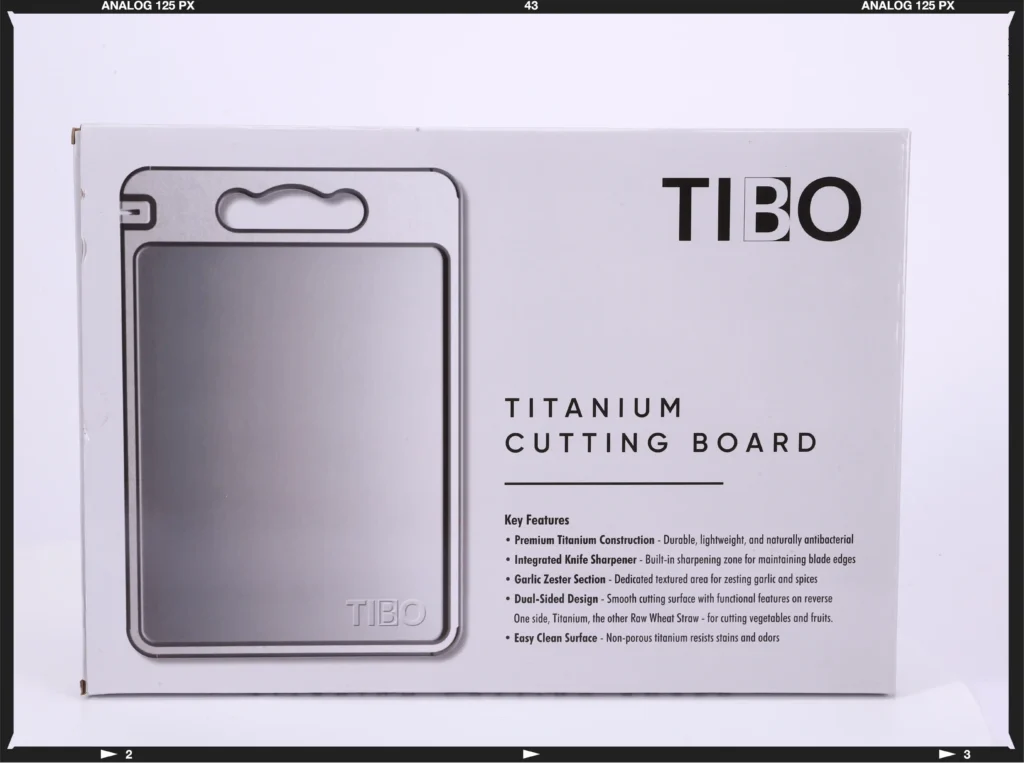
TIBO is a dual-sided cutting board produced by ZS Brands (Covington, Georgia). One side is food-grade titanium; the other is a wheat straw/PP composite. It launched in late 2025 into a growing market of consumers concerned about microplastic contamination and kitchen hygiene.
The product’s full feature list:
- Medical-grade titanium cutting surface (one side)
- Wheat straw/BPA-free PP composite surface (other side)
- Built-in ceramic knife sharpener
- Integrated garlic grater/mincer
- Deep perimeter juice groove
- Anti-slip base
- Hang hole for storage
- Dishwasher safe, no oiling required
Price at time of writing: approximately $59.99 USD. Always verify current pricing directly before purchasing — prices and bundle deals change.
The Science They’re Actually Getting Right: The Microplastic Problem
TIBO’s core marketing hook is microplastic contamination from plastic cutting boards. This isn’t fearmongering — it’s documented science.
A peer-reviewed study published in Environmental Science and Technology (May 2023) by researchers at North Dakota State University, led by Himani Yadav, documented significant microplastic particle shedding from plastic cutting boards during normal food preparation activities. The study was published in the American Chemical Society journal (DOI: 10.1021/acs.est.3c00924) and specifically found that standard plastic boards can shed massive quantities of microplastic particles annually through everyday chopping — the same particles that end up in your food.
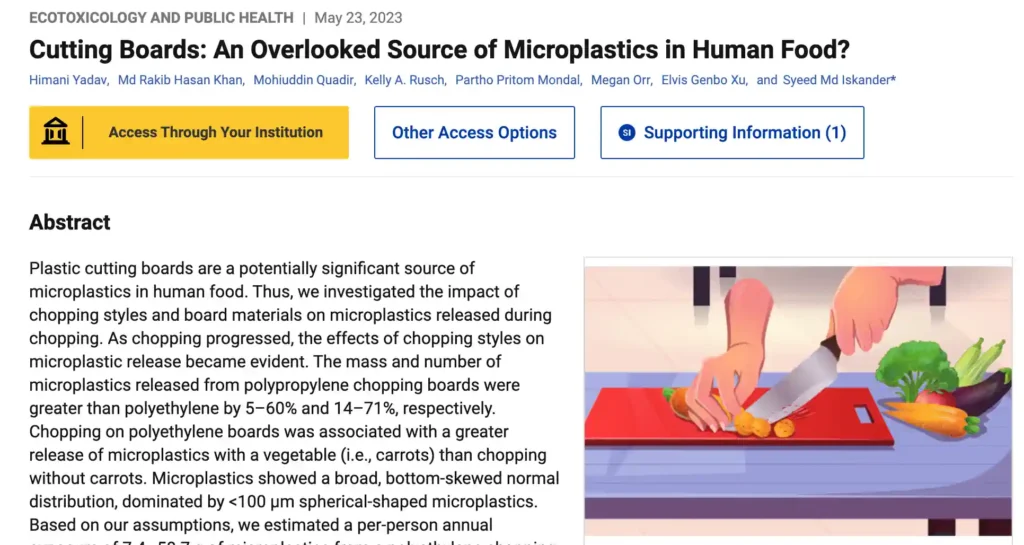
This is real science cited in a real journal. The concern driving the titanium cutting board category is legitimate.
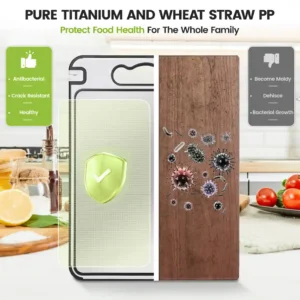
Wooden boards present a different but equally valid concern: porosity. Wood is absorbent. Every knife cut creates a micro-groove where bacteria, moisture, and food residue accumulate. The surface looks clean; what’s underneath isn’t. It’s why commercial food preparation codes generally require non-porous, replaceable surfaces.
Titanium solves both problems in one board: it doesn’t shed particles, and its non-porous surface won’t harbour bacteria.
TIBO Cutting Board Full Review: What Actually Works?
✅ Hygiene Advantage: Genuinely Significant
The titanium surface is non-porous. Bacteria, mold, and food odours have nowhere to penetrate. You can fully sanitise it — not just surface-clean it. For anyone prepping raw chicken, fish, or meat regularly, this is a meaningful food safety upgrade.
Compare that to a wooden board you’ve had for two years. Those dark lines around the knife marks? That’s bacteria. You can’t scrub out what lives inside the surface.
✅ Zero Microplastic Contamination: Verified by Material Science
Titanium doesn’t shed. Unlike HDPE or polypropylene boards — which visibly groove and scar under daily knife use — the titanium surface doesn’t break down into your food. This is one claim that the material science fully backs up without caveats.
✅ Dual-Sided Design: Practical, Not Gimmicky
Using the titanium side for raw meat and the wheat straw side for produce/bread is a genuinely useful cross-contamination workflow. It effectively replaces two boards. For home cooks who are serious about food safety but don’t want to manage a collection of colour-coded boards, this is a real convenience win.
✅ Zero Maintenance: The Hidden Selling Point
This gets undersold in most reviews. Consider what a wooden board actually demands: regular oiling with food-grade mineral oil, hand washing only (no dishwasher), occasional sanding to remove deep grooves, and eventual replacement when the surface is too scarred to clean properly. All of that goes away with TIBO. Dishwasher it. Done.
For daily cooks, the time and mental load saved over a year adds up to something real.
✅ Built-In Sharpener and Garlic Grater: Genuinely Useful Additions
The ceramic sharpener won’t replace a proper whetstone session for serious knife nerds — but for home cooks who want a quick edge refresh before dinner without hunting for a separate tool, it does the job. A comparable standalone ceramic sharpener typically costs $50–80. The garlic grater/mincer is small but actually cuts prep time for aromatics.
✅ Durability: Built to Last
Titanium doesn’t warp, crack, peel, or absorb stains. This isn’t a board you’ll replace in 18 months. As a one-time purchase that genuinely lasts, the lifetime value argument holds up.
TIBO Cutting Board Honest Cons: What the Other Reviews Aren’t Telling You
❌ The Knife-Friendly Claim Is Only Partially True — and That Matters
This is the most misleading aspect of TIBO’s marketing, and it gets repeated uncritically in virtually every affiliate review online.
The brand says titanium is “softer than knife steel,” so it won’t dull your blades. Here’s the actual picture:
Pure titanium measures around 36 HRC on the Rockwell hardness scale. Most kitchen knives range from 55–67 HRC. So yes, titanium is technically softer than the steel it contacts.
But knife dulling isn’t purely a hardness game.
Independent material testing and knife sharpening professionals consistently report that titanium accelerates edge wear compared to quality wood or HDPE plastic boards — not because of hardness alone, but because of frictional and adhesive wear. When your blade slides across a titanium surface, there is zero give. No cushioning. Every cutting stroke focuses full force directly on the blade edge, creating micro-abrasion and edge rolling over time.
Wood — particularly end-grain hardwood — works differently. The knife slides between wood fibres, which then spring back. The surface absorbs impact. The blade is protected.
The practical upshot: on titanium, you’ll need to sharpen your knives more frequently than on a quality wood or HDPE board. The built-in sharpener on the TIBO is, at least in part, an acknowledgment of this reality — it’s there because you’ll need it.
Who should be most concerned: Owners of Japanese knives (Shun, Miyabi, Global) with hardness ratings of 60–67 HRC and thin acute edge angles are most vulnerable to accelerated chipping on hard surfaces. German-style knives (Wüsthof, Henckels) at 54–58 HRC with thicker edges are more forgiving.
The bottom line: Titanium is better for knives than glass or ceramic boards. It is worse than end-grain hardwood or quality plastic. That’s the honest answer, and it’s not what most TIBO reviews tell you.
❌ “Pure Titanium” vs “Titanium Alloy”: A Branding Discrepancy
TIBO’s marketing website and most affiliate content say “100% pure titanium” and “medical-grade titanium.” The official Amazon listing says “premium titanium alloy.” These are materially different descriptions.
One independent review confirms the board uses Grade 2 titanium, which is commercially pure titanium (99.2%+ titanium content). Grade 2 is legitimate food-grade titanium commonly used in food processing equipment. It’s not a scam material, but it’s not “100% pure” in the absolute sense, and calling it equivalent to surgical-grade medical titanium is a stretch.
❌ The Metal-on-Metal Sound: Minor but Real
Cutting on titanium produces a harder, higher-pitched sound than wood. Most users adjust within a few sessions. It’s a minor con, but if you’re a pre-dawn meal prepper or share a kitchen with light sleepers, it’s worth knowing before you buy.
Who Should Buy the TIBO Cutting Board?
✅ You’ll Love It If | ❌ You Should Pass If |
|---|---|
You cook meat 4–5x per week and want genuine hygiene assurance | You own Japanese knives worth $150+ and want maximum edge longevity |
You’re done with the oiling/maintenance ritual of wood boards | You want independently lab-certified material claims before buying |
Microplastics in food are a real concern you want to act on | You rely on the 60-day guarantee — verify the real policy first |
You want one board that replaces two | You’re an occasional cook and won’t get full long-term value |
You want dishwasher-safe simplicity | You prefer the feel and sound of cutting on wood |
TIBO Cutting Board vs The Competition: How It Stacks Up?
Board | Hygiene | Knife-Friendly | Durability | Maintenance | Starting Price |
|---|---|---|---|---|---|
★★★★★ | ★★★☆☆ | ★★★★★ | ★★★★★ | ~$60 | |
John Boos End-Grain (Maple) | ★★★☆☆ | ★★★★★ | ★★★★★ | ★★☆☆☆ | $120–$200 |
OXO Good Grips HDPE Plastic | ★★★★☆ | ★★★★★ | ★★☆☆☆ | ★★★☆☆ | $20–$35 |
Generic Amazon Titanium Boards | ★★★★☆ | ★★★☆☆ | ★★★☆☆ | ★★★★★ | $20–$35 |
Glass/ Tempered Boards | ★★★★★ | ★☆☆☆☆ | ★★★★★ | ★★★★★ | $25–$50 |
Notes:
- The John Boos end-grain board is the superior choice if knife protection is the priority. But it costs 2–3x more, needs regular oiling, and won’t survive dishwasher use.
- NSF-certified HDPE plastic is still the commercial food service standard for a reason — cheap, replaceable, and genuinely knife-friendly. Its weakness is microplastic shedding as it ages.
- Generic titanium boards on Amazon at $20–$35 are almost certainly not using food-grade Grade 1 or Grade 2 titanium. A simple test: real titanium is non-magnetic. Hold a fridge magnet to the surface — if it sticks, it’s stainless steel, not titanium.
How to Verify Your TIBO Cutting Board Is Authentic?
The brand itself warns about counterfeits. Here’s a quick authenticity check any buyer can do at home:
The magnet test: Real titanium is non-magnetic. Press a fridge magnet firmly against the cutting surface. If it sticks, the board is stainless steel — not titanium. A genuine TIBO cutting board will show no magnetic attraction.
Buy only from here directly or verified retail listings (Walmart). Third-party marketplace sellers, particularly on Amazon, may be selling inferior copies.
How to Clean a TIBO Titanium Cutting Board?
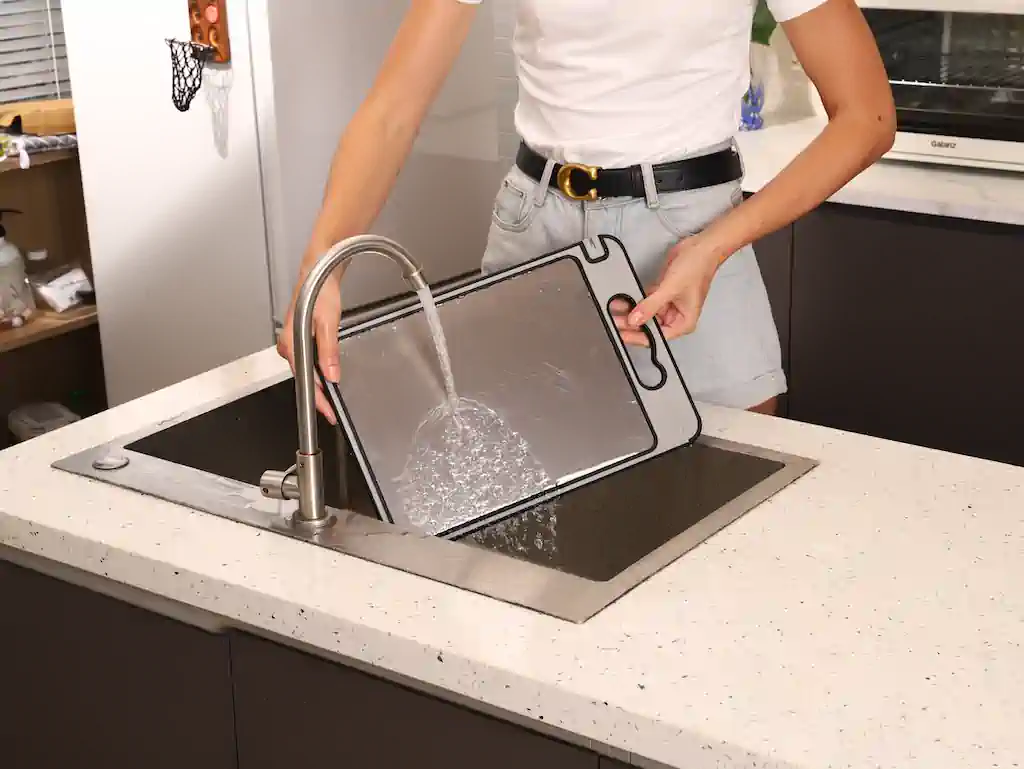
This is one of the board’s strongest selling points: zero complexity.
Daily use: Rinse with hot water and dish soap. Wipe dry or air dry via the hang hole.
After raw meat: Hot water, dish soap, thorough rinse. Optionally, sanitise with a diluted white vinegar solution.
Deep clean: Dishwasher, top rack, standard cycle.
What you never need to do: Oil it. Season it. Sand it. Baby it.
Avoid abrasive steel wool pads on the titanium surface — though given how hard titanium is, you’re unlikely to damage it regardless.
Frequently Asked Questions:
Should You Buy the TIBO Cutting Board?
Buy it if:
- You prioritise zero-maintenance, maximum-hygiene food prep
- You regularly handle raw meat and want genuine cross-contamination protection
- You’re tired of oiling, seasoning, or replacing wooden and plastic boards
- You’re not invested in high-end Japanese knives that require careful edge preservation
Skip it (or hold off) if:
- You own premium knives and want to maximise edge retention
- You want to verify independent lab testing before buying into “medical-grade” claims
- You’re already using NSF-certified HDPE plastic boards and replacing them regularly (truth: you may already be fine)
For the right buyer — health-conscious, daily home cook, done with the oiling ritual, not precious about their knife collection — this earns its counter space.
👉 See current TIBO pricing and bundle deals
Disclosure: This review contains affiliate links. If you purchase through these links, I earn a commission at no additional cost to you. All editorial positions are my own. The return policy discrepancy cited in this article was originally documented by Yahoo Finance/GlobeNewswire in December 2025. Microplastic research attributed to Yadav et al., Environmental Science and Technology, May 2023 (DOI: 10.1021/acs.est.3c00924). All pricing should be verified directly with the manufacturer prior to purchase.
TIBO Titanium Cutting Board
TIBO titanium cutting board reviewed by a real cook. Non-porous, zero microplastics, dishwasher-safe — but is the knife-friendly claim true? Read before you buy. Dual-sided medical-grade titanium cutting board with built-in ceramic knife sharpener, integrated garlic grater, and wheat straw reverse side. Non-porous, dishwasher safe, zero microplastic shedding.
Product Brand: TIBO
Product Currency: USD
Product Price: 59.99
Price Valid Until: 2026-09-30
Product In-Stock: InStock
4.5